Q: Who may purchase a deed to your claim?
A: Anyone in the
World may purchase a deed to the ISLE claim. This was the
foundation for the thought behind this lengthy process in
the beginning. The claim was initially established with the
thought that "if enough people of like mind and good will were
to have just "ONE" acre or parcel of the ISLE claim, then
everyone would have a share in what has been referred to as...
the 'Common Heritage of Mankind.'
Q: How did this
claim come about?A: The initial concept came about one night
when considering 'who actually owns the sea'. When breaking it
down and upon initial research it was easily discovered that,
while the 'sea' or 'ocean waterways' are considered world-wide
to be 'International Free Passage' and 'Flagship' laws applied,
the laws regarding the actual deep-sea bed were much thinner,
confusing and questionable.
Further research uncovered the fact that countries owned the
property, or 'seafloor' out to the end of 'Their Own Continental
Shelf', or 200 miles whichever was furthest..."ANYTHING AFTER
THAT HAS BEEN LEFT 'UNTOUCHED AND OVERLOOKED' BY WORLD
LAW"...then while spoken of rarely, what of those countries with
no Ocean borders? Then around 1975 (early-mid 70's-80's) when the United Nations
and U.S. were the main players in the forming of the Third World
LOS (Law Of the Seas), there
paranoia about 'control' was pressed into action by R.W. Schott.
Basically, when Bob Schott's claim to PREVIOUSLY "UNCLAIMED
PROPERTY" was "FIRST, FOREMOST AND PARAMOUNT as it was made
during the early beginning years of the Third World LOS. Conferences where over 130 countries participated for
several years yet could not come to an agreement over even half of the topics
and suggestions discussed."
Q: What
sparked the United States and the United Nations to 'get around'
to frantically push for a 'hurried passage' of the 'Third World
Law of the Sea Treaties and Control of the World's Seabed's?'
A: First off, at that time up to the minute
news and information did'nt exist as it does with todays
adavanced internet systems. At that same or very close
approximational time 1975 both R.W. Schott aka ISLE
(International SeaLand Enterprises(
tm)
and one lone other company Deepsea Ventures Inc Mining firm out
of Virginia both made separate claims, neither of which new of
the other at the time as the process for ISLE was far more
extensive it also took Deepsea Ventures some time to perform
their own project. Far greater in size, Deepsea Ventures's claim
was aprox 10,00 sq. miles specifically purposed for deepseabed
mining only, while ISLE/R.W. Schott's claim was much larger ie;
6m sq miles. Deepsea Ventures claim they pursued lies within
ISLE's claim and R.W. Schott acknowledged their claim as
professional courtesy and to avoid any unecessary complications
as it was slightly questionable as to which one actually began
their Deepsea Bed resource project first. Also there were
actually only about 2 or three vessels in the world that had the
capability of reaping the rewards that the oceans sea floor
contain. Howard Hughes Glomar Explorer (Occasionally used as a
spy recovery ship) was one of them. Also, although the Ocean's
seabed contains a wealth of mineral deposits and riches, the
Pacific Ocean is extremely deep and is basically 'unreachable'
or 'unusable', but then, and still today, the question is...for
how long?
Q: What is there that makes the ISLE Claim
legitimate? A: Bob's claim is
partially akin to that of the early
prospector's in the Gold Rush days. At the time, and most
importantly, Bob (RW Schott/ISLE) established
his claim when there were no such International or universally
accepted existing laws governing the property, control or
rights
of the deep sea beds, only the waterways above. You can check
out the
History Credibility section to get a summary brief of
exactly what is in the ISLE SeaLand Claim Deed Kit.
Additionally, the only laws which existed were the
International Rights of Passage Over the High Seas, as stated, not below it,
and the only fairly commonly accepted laws were those which stated that each country
that bordwers the oceans, controls the ocean waterways and
ocean floor out to their own continental shelf or 200 miles from
shore, whichever is 'natural. This is an extension of the old
maritime law which incorporated the 3 mile limit. The reason for
the 3 mile limit in the olden days (those of the Pirates 16th
century and before, was basically a defense
position that - that was as far as the canons could shoot in those
days. Another factor stretching as far as today, was that as
mentioned, there are limited ships/vessels
equipped with the technology to actively mine the minerals of
the oceans seabeds at the great depths,especially in the Pacific
Region, so it all remained drastically
overlooked as there was no apparent threat to this massive area
of wealth which lies at the bottom of the oceans of the world.
Using an eggagerated example, it's like what if it were proven
that on the farthest planet from earth 'Pluto' there were
monstrous Gold nuggest just covering the entire surface...it's
out of reach out of touch and how are you going to get it???
Q: Is this claim credible or is it just a novelty?
A: Well, if you call it that it would arguably
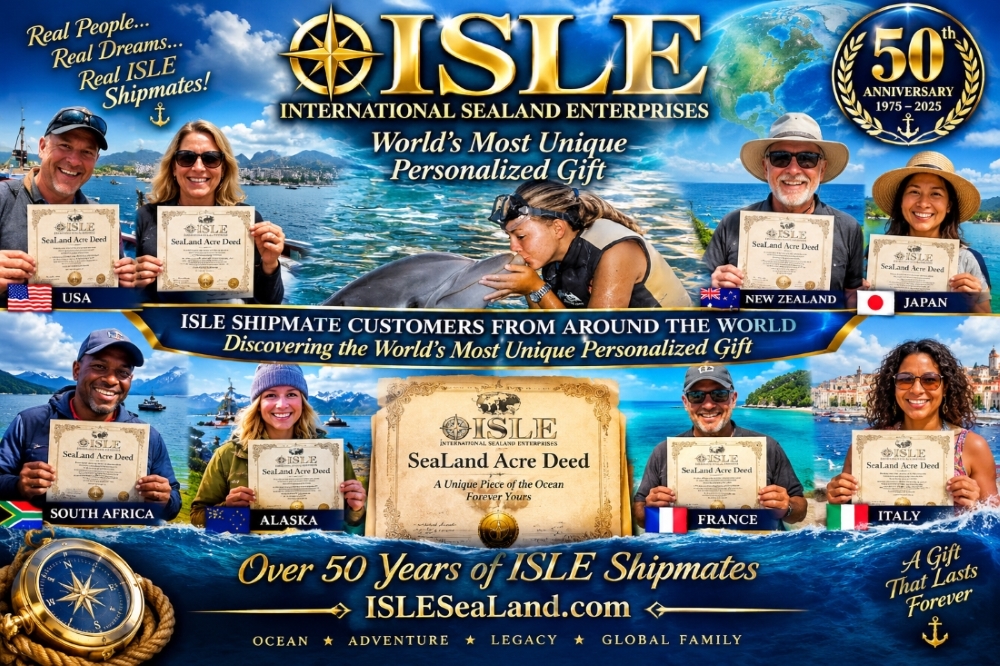
be the most detailed extensive educational novelty with a 50yr Uncontested
Unchallenged HIstory of loyal customers ('ISLE Shipmates') you'll
find, refer to
ISLE Photo Testimonial section you should find it
revealing). You would also have to refer Deepsea Ventures Inc a
Deepsea Mining firm from VA and from almost the exact same time
period but unknown by each other at the time, not to mention the
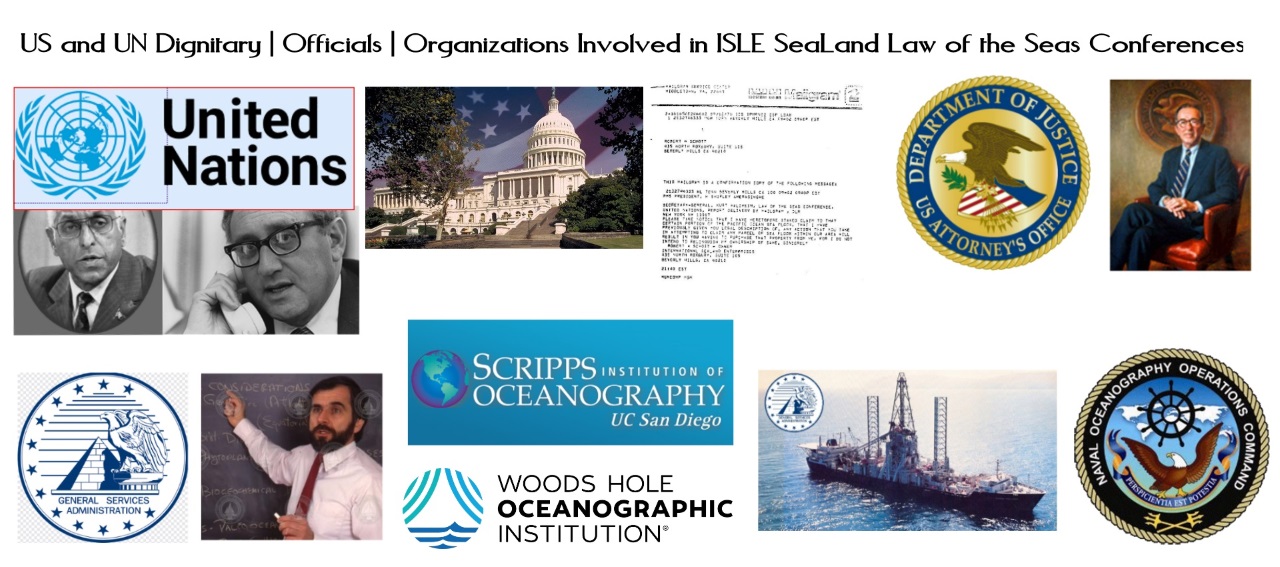
extensive and credible U.N. and U.S. dignitaries and Maritime
and Global Organizations. So as a novelty? It's far more
detailed, extensive, Tenable and involved than that, but you can
of course refer to it as you want, but more acuratley, there is
no gift like the ISLE SeaLand Claim Deed Kits on earth it is
truly One-of-its-Kind). The
ISLE Kit includes details on this coincidental situation, it's
most interesting. *(Also you can refer to the Question:
(Why should I buy a Deed
to property located under the sea?)
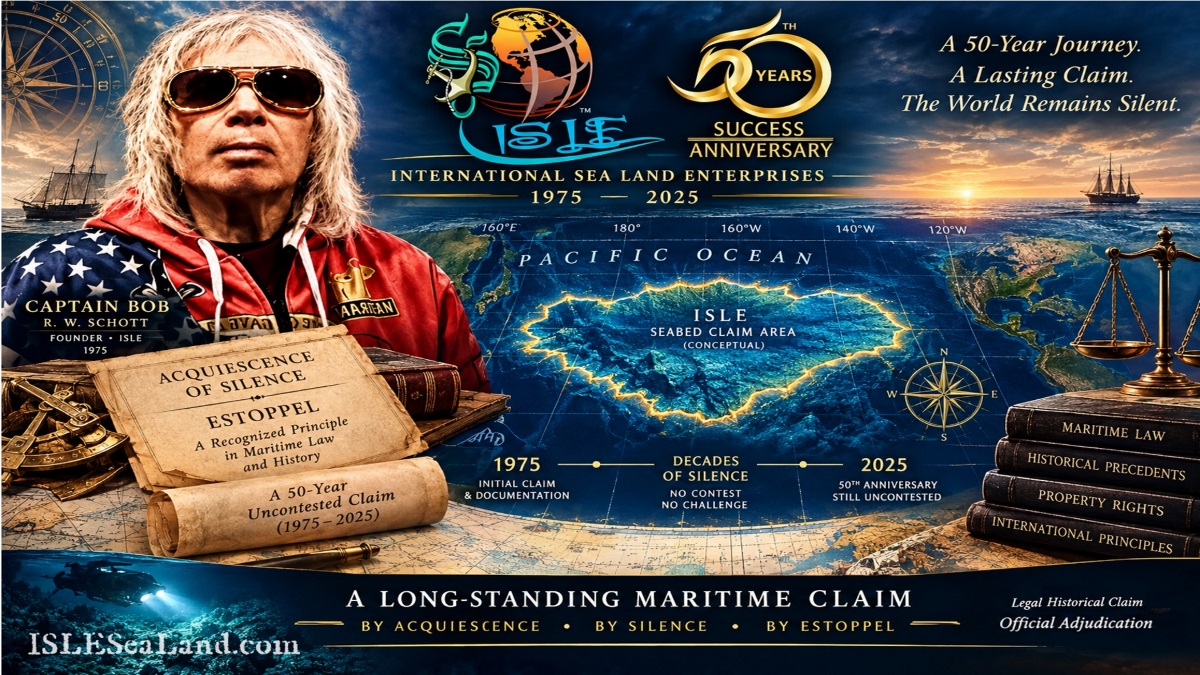
Bob and ISLE SeaLand are Celebrating the Uncontested,
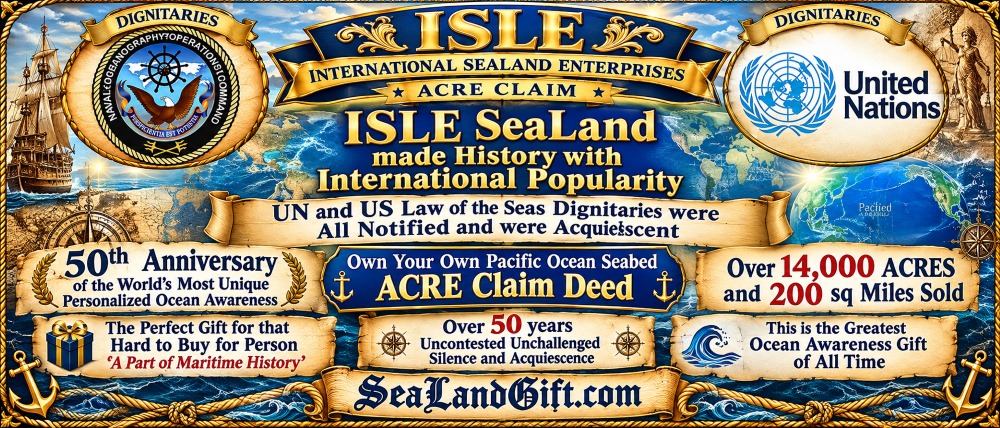
Unchallenged and Tenable 50th Year Anniversary and has proven to
be the most unusual unique and hard to find personalized gift in
the world, not to mention a great educational Maritime awareness
Gift. The ISLE SeaLand gift kit remains unchallenged,
uncontested and
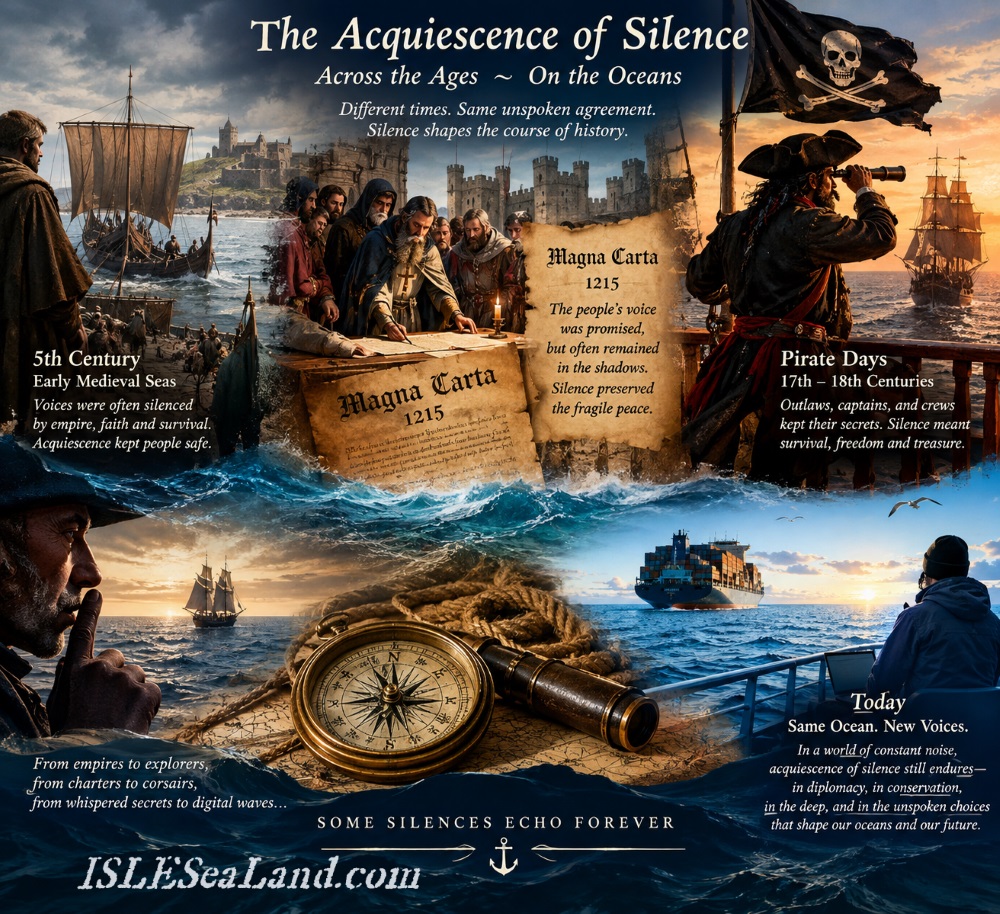
credible by the acquiescence of silence or lack of authority by
all those notified originally. ISLE's claim has years of
research and diligent vested work involved. Notices of the claim
were given to the United States, Governor Stanton's office in
Washington D.C., the United Nations and Major countries of the
world. It was Bob Schott himself that actually forced the Third
World Law of the Seas Conferences to press forward to try to
arrive at a unilateral treaty to govern the deep seabed's of the
world. Here was the problem, the United States admitted they had
no 'authority' and neither could any other country. The U.S.
couldn't say they had authority to deny or acknowledge this
claim due to the fact that IF they DID either 'Acknowledge or
Deny, this in itself would be a bold statement of an
authoritative ownership stance. In other words, they couldn't
say Bob Schott's claim was valid or invalid because to do so
would put them in a very delicate World Wide political problem
area. In short, they got caught with their political 'pants
down' on this issue. This was why after receiving numerous
notices from Bob Schott and ISLE they became very nervous and
frantic in their attempts at arriving at a unilateral agreement
for a U.S. / U.N. treaty for deep seabed control. No Treaty was
ever arrived at as the over 130 countries of the world could not
put their 'egos' aside and arrive at a fair and equitable
agreement, an agreement which never should have been sought, as
these very governing bodies of the world that are compelled to
try to control everything in their path would have violated the
very statement they all used to defend their actions, that
statement was 'The Common Heritage of Mankind'. It is on this
note and due to this very statement that Bob Schott and ISLE
have built into their operations, as if enough people of
goodwill and like mind all join in and have even just one acre,
we as 'Mankind' can all ably retain and protect this 'Heritage'
of The 'Last Frontier' on Earth. This is why Bob Schott and ISLE
are only charging a nominal fee of only $39.95 (Initial Price
was $19.95) for an acre. Not much considering all the years of
dedicate hard work, legal fees and research. *(Note: Please
visit the U.N. bills section on this site for further proof of
what the Third World Law of the Seas Conferences were all about
and also see the legal section for further support of the
validity of Bob Schott and ISLE's claim. If after all of what
you see on this site you are still skeptical, then you can call
this a novelty if you like, but what if?, what if? In other
words, what you are buying is this, years of research, legal
notifications, educational wealth on the last frontier on earth
and a great conversation piece, now if all of that's not worth a
mere $39.95 then the prices of movies should way down, because
you can't even take yourself and a guest to the movies for that
price anymore. The buyer is being conveyed only such title as
Bob Schott and ISLE are vested with and to date Bob Schott's
claim has never been contested. In other words, this is 'Man's
chance to take a chance'.
Q: Can anyone else establish even a
plausible semblance of such a claim as ISE in this region or any
other areas or Oceans of the world?
A: That's exactly what
the United States, and the United Nations were trying to prepare
for. The United States 96th Congress Passed their only Public
Law Bill on this issue in June 28, 1980,
(aprox. 7 years after Bob's ISLE SeaLand Project). 1980
(Public Law 96-283; 30 U.S.C. 1401 and following) and amendments
thereto. DEEP SEABED HARD MINERAL RESOURCES ACT1 [Public Law
96-283, Approved June 28, 1980, 94 Stat 553] [As Amended Through
P.L. 107-273, was Enacted November 2, 2002 (over 27 years after
Bob's ISLE SeaLand Project). This publication is a compilation
of the text of Public Law 96-283, which NOW basically controls
any U.S. citizen or company from mining the deep sea bed.
However, this was between 7 and 27 years AFTER Mr. Schott's
initial claim efforts and does not include control for the
deepsea bed in general, nor does it involve control specifics
for other countries. It is this Law Bill, the only one they were
able to pass, that contains every by-law Bob Schott thought up
and designed for ISLE. So to accuatley answer this question
bluntly - ''It'd be complete Waste of a Lot of Time, effort and
expense', you'd be 50 years too late!
Q: What should I expect when considering
buying a claim Deed Kit and what do I get for my $39.95?
A:
Originally the ISLE Kits were priced at $19.95 and were also
promoted by the ICONIC 105 year old Johnson Smith Company
catalogs, also at the same price, so as you can see, the price
has gone up, not down, but what else hasn't right?
As stated earlier, you can call this a novelty if you like, but
that is honestly an injustice as
it's far more Tenable than that, and just ask - what if?.. as
it's 'Man's Chance to Take a Chance''. Bob Schott and
the legal entity behind ISLE believe they have a just and valid
claim to this heretofore unclaimed property. Schott's claim was
first, foremost and Paramount in many respects. The United
States admitted in a letter to Bob Schott that they had no
authority over this area and did not want to circulate any
information of this claim to the UN delegates during the Third
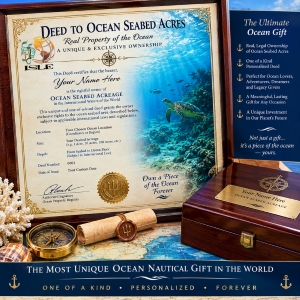
World Law of the Seas Conferences.. Here's what you get: A
beautifully Framable deed, a map showing the property area where
your deed represents, a copy of Bob Schott's original
'Attorney's Certificate of Title' from the now retired attorney,
Mr. Oscar B. Ladner, a prominent trial attorney featured in
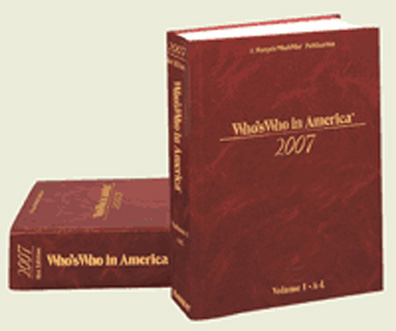
'Who's Who in American Law', his conversations with then U.S.
Attorney General
Q: Why should I buy a Deed to property
located under the sea?
A: 'If
you're looking for a truly Only One-of-a-Kind Personalized Gift
this is definitely for you. It is an Historical' great conversation
piece and most of all, to take part in what has historically
been referred to as 'The Common Heritage of Mankind'. Take part
in the Most sophisticated World-Wide legal battle of the last
three centuries. Plus, it makes a great conversational and
educational gift for the person who has everything.And both you
and/or the recipient of your gift will truly become a Part of
Maritime History as illustrated when you receive your
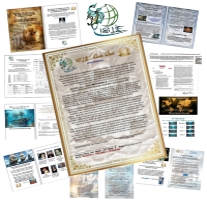
Credibility and Background Documents showing the Global
Dignitaries involved in the project.Or, if you just want you can
call it a novelty if you like, but no novelty has ever shown the
history that went into ISLE SeaLand. So, enjoy!
Q:
What is the size of your claim?
A: Bob Schott and ISLE's
claim is over 6 million square miles of the East Pacific Ocean
seafloor.
Q: How did you arrive at the boundaries and
area size?
A: Now of course someone
had to ask this question because this was a monumental plotting
endeavor too detailed to even try to list here but included
numerous global organizational help, even the U.S. Navy
Oceanographic Center was an assist as well as Scripps Institute
and numerous others. (You'll see all of this in the ISLE
Kit). But...The Boundaries established and claimed by Bob
Schott and ISLE were arrived at by first researching continental
shelf in proximity to the United States and West Coast of Canada
and Mexico . Secondly Bob Schott enlisted the services of a top
Oceanographer for the Navy and Scripps Institute in, California.
There is, however, one very small area in which the claim lies
just inside of the 200 mile zone off of the Western United
states coastal area but that has been relinquished and no claim
of ownership is being asserted by Bob Schott and ISLE for that
particular small parcel of seabed. It also honors s similar
claim (of only about 10,000 sq. miles) by a large Deed Sea bed
mining company which took place around the same time. Their
intent was to use it as deepsea mining of resources. Their area
was in a shallower depth than the normal depths of the E.
Pacific Ocean region for the most part, making it do-able.
Q: Is there any limit on how many deeds I can purchase of
ISLE?
A: Only to the extent of ISLE's original claim size
with the mentioned restrictions. The Claim Deeds are for ACRE
and/or MILE.
Q: How did Mr. Schott's 'By Laws' which he
designed for ISLE become included in the "proposed" U.S. Law of
the Seas and HR bills?
A: This is
the shortest answer I've ever had to give, Basically, "COPY AND PASTE".
Q: How can I use my Deed?
A: First and
foremost we recommend reviewing some of the ISLE Shipmates
Testimonials, they provide a most interesting array of ways they
used their deed kits and will help give you sme ideas. Secondly
this is a tremendous
Educational and conversation piece, gift, of Maritime Historic
value (If you like).
If you have a vessel with enough technology maybe you can go
mining for the minerals of the sea. If you do, let us know what
you come back with, and don't worry about owing Bob or ISLE a
royalty, if you have your Claim Deed signed, with ref# and
Lat/Long it's yours. *(However, Bob Schott and ISLE are not
responsible for shark attacks, jellyfish stings or getting a
case of 'The Bends'). By the way, Bob tells of an extremely
dangerous closeup incident that happened years ago with the the
absolute most Venomous creature on earth and yes, it comes from
the Seas. The details of the sea creature and the close
contention incident are detailed inhis eBook, 'Creatures of the GOOD, the BAD and
the UNKNOWN' available here on the ISLE Site and Amazon and
Barnes & Noble.






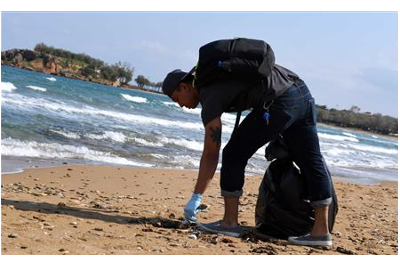 Help Preserve our Valuable Ocean's
Resources and Sea Life
Help Preserve our Valuable Ocean's
Resources and Sea Life